In one national QSR’s app, 47,000 regulars spent as much as 602,000 one-time customers. Here’s what speakers from RZR, Branch, Singular, Magnite and Polymarket said about winning the second order and every order after it.



One-time customers are the free samples of QSR app marketing: plenty of takers, not much revenue.
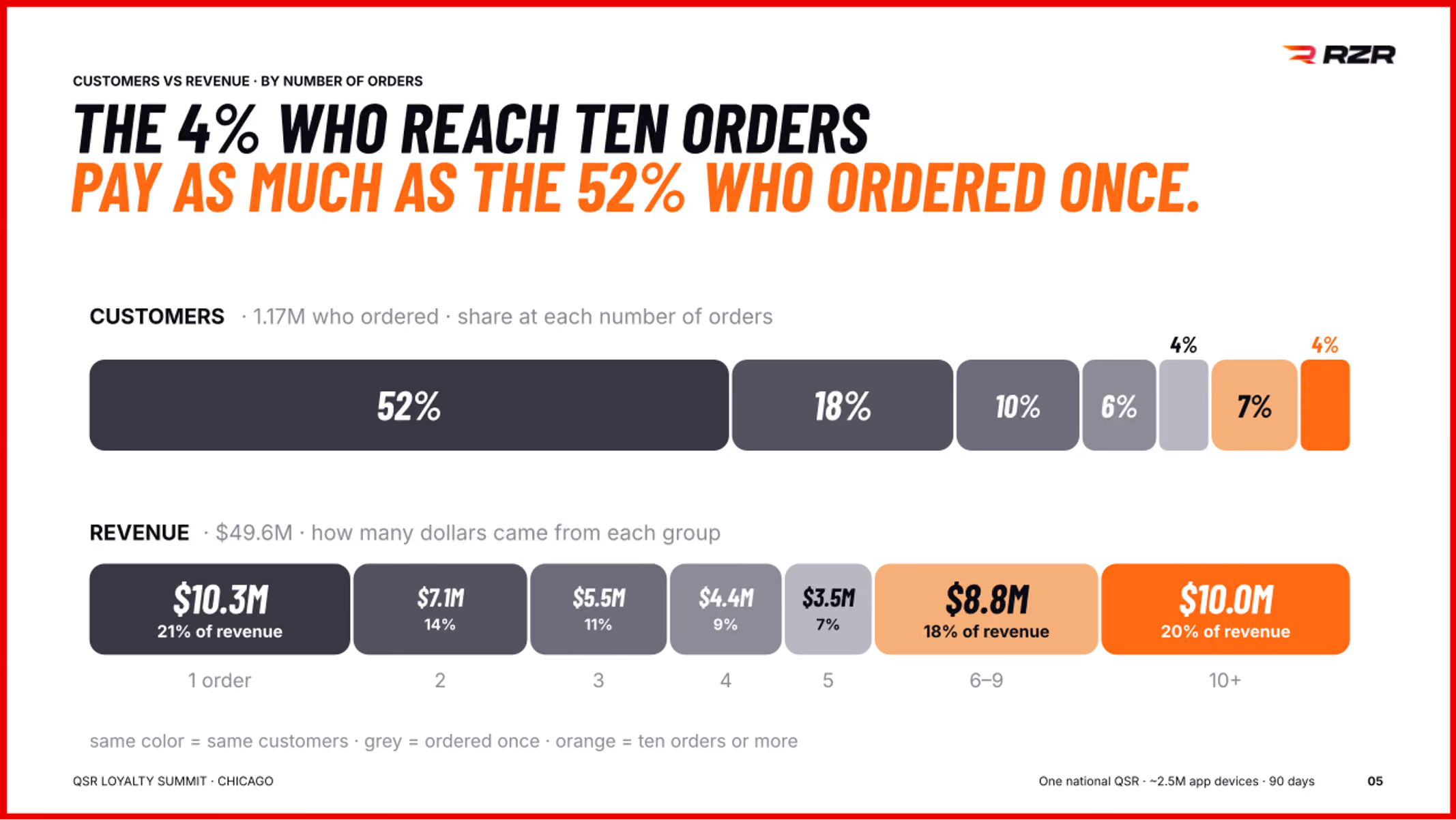
In one national QSR’s app, 602,000 people ordered once in 90 days and spent about $10 million. The 47,000 regulars who ordered ten or more times spent the same.
Most budgets still chase the one-and-done crowd. The money is in the second order, the third and the tenth.
That data, shared at RZR’s QSR Loyalty Summit in Chicago on October 13, set the tone for the afternoon. Speakers from RZR, Branch, Singular, Magnite and Polymarket kept returning to the same question: what happens after the first order? Here are ten takeaways for user acquisition, retargeting and CTV.
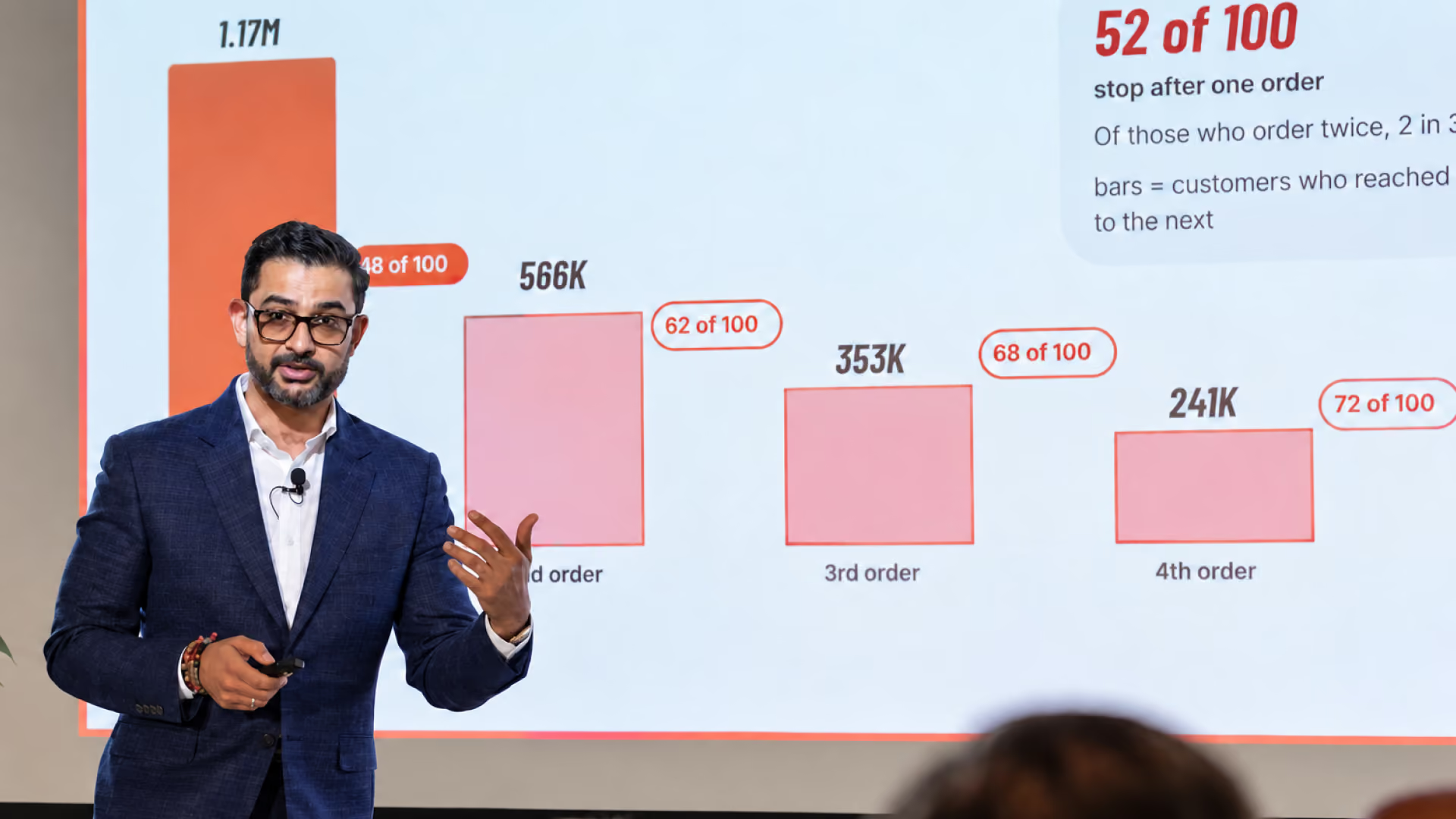
Only 48 of every 100 first-time buyers ordered again within 90 days. Clear that hurdle and the odds keep climbing: 62 of 100 two-time customers placed a third order, then 68, 72 and 74.
"Everybody focuses on the install or the first order," Sareen said. "But the key is how to get the second order."
Anthony Khaiat, Senior Data Scientist at Polymarket, sees the same in prediction markets: a first trade often rides on a promo, so the second is the real signal. The same goes for a free sandwich.
Try this: Give the second order its own budget line and its own success metric.
"I don't think you would consider a customer a customer if they've just installed your app," said Andrew O'Connor, Enterprise Account Executive at Singular. Yet some QSRs still count installs as acquired users, and MMP attribution ties everything to the install by default, a setup he called legacy. Steve Massaro, RZR's Global Head of Agencies, warned against chasing "a 50-cent CPI on iOS" that never turns into orders.
Try this: Optimize QSR user acquisition toward a second purchase or predicted customer value. Report installs as a cost, not a business result.
Loyalty reports usually track sign-ups, points and push opens. Sareen took each one apart: a sign-up “is just somebody filling a form,” points can reward people who would have come anyway, and an open is just “a tap on your phone.” His measure of loyalty is orders: “how many orders a customer is getting through the door, through an app, through walking into the physical store.”
Promos blur the picture. A first order often rides on a free meal or a half-off offer, so on the measurement panel I moderated, we talked about setting the loyalty bar at two orders, or even four, based on your own MMP data. When an attendee asked how to tell loyal customers from coupon chasers, Sareen pointed to the brand’s CRM: find the “churn and burn” customers and leave them out of the media plan.
Circana’s 2025 data points the same way: loyalty members visit 20 restaurant chains a year, as many as nonmembers.
Try this: Lead your loyalty report with repeat-order rate by cohort, and move sign-ups and points below it. Use your MMP data to set the order count that makes a customer “loyal”: two orders, or four. Flag customers who only order with a promo, and test leaving them out of paid media.
With RZR's media paused for a week, the top 8% of customers still produced 43% of the next week's revenue. Devoted customers reordered at 55%; browsers, at under 2%.
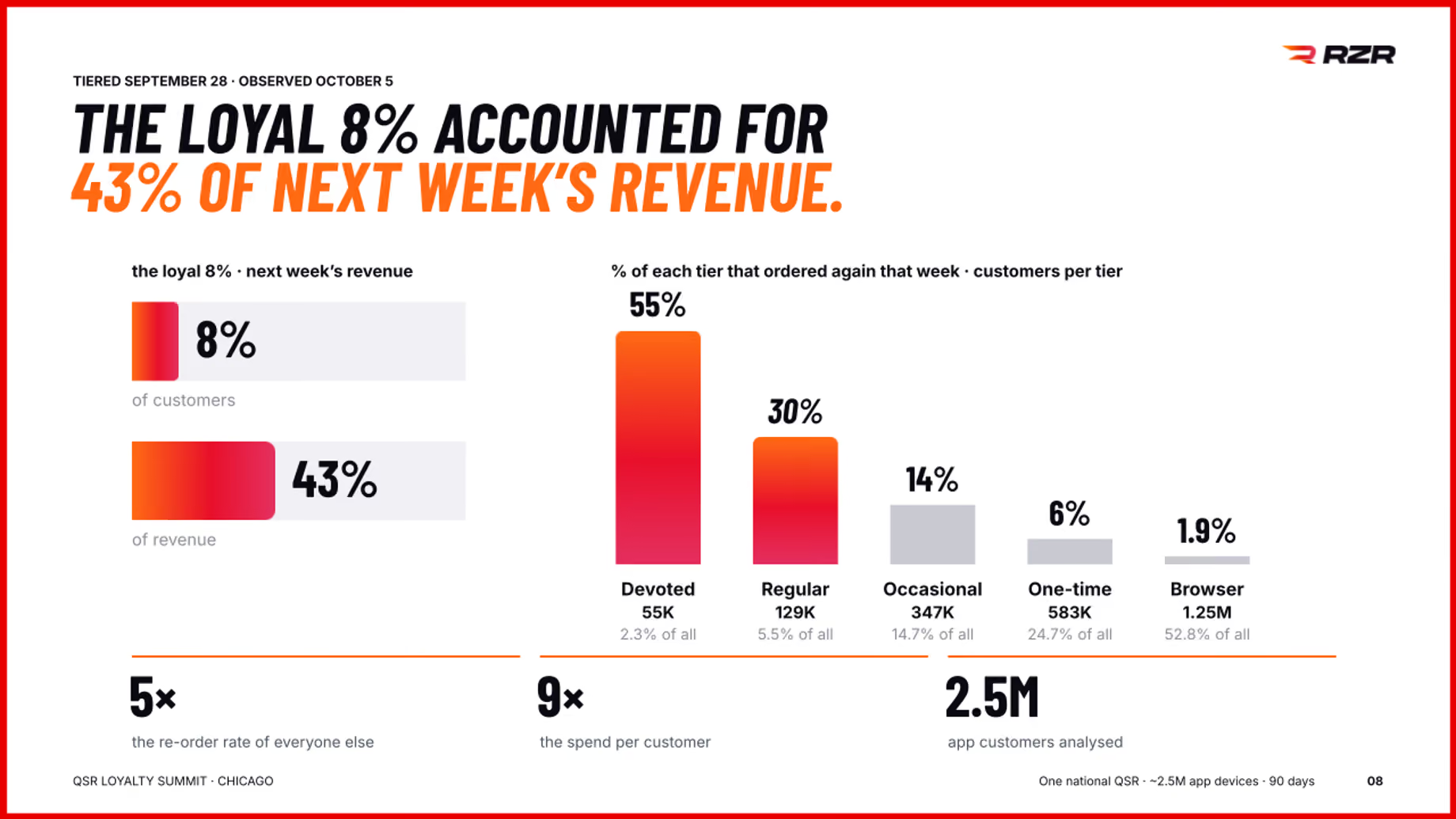
"Your regular folks, you just let them be because they will keep coming back again and again," Sareen said. "And that's where media planning fails today."
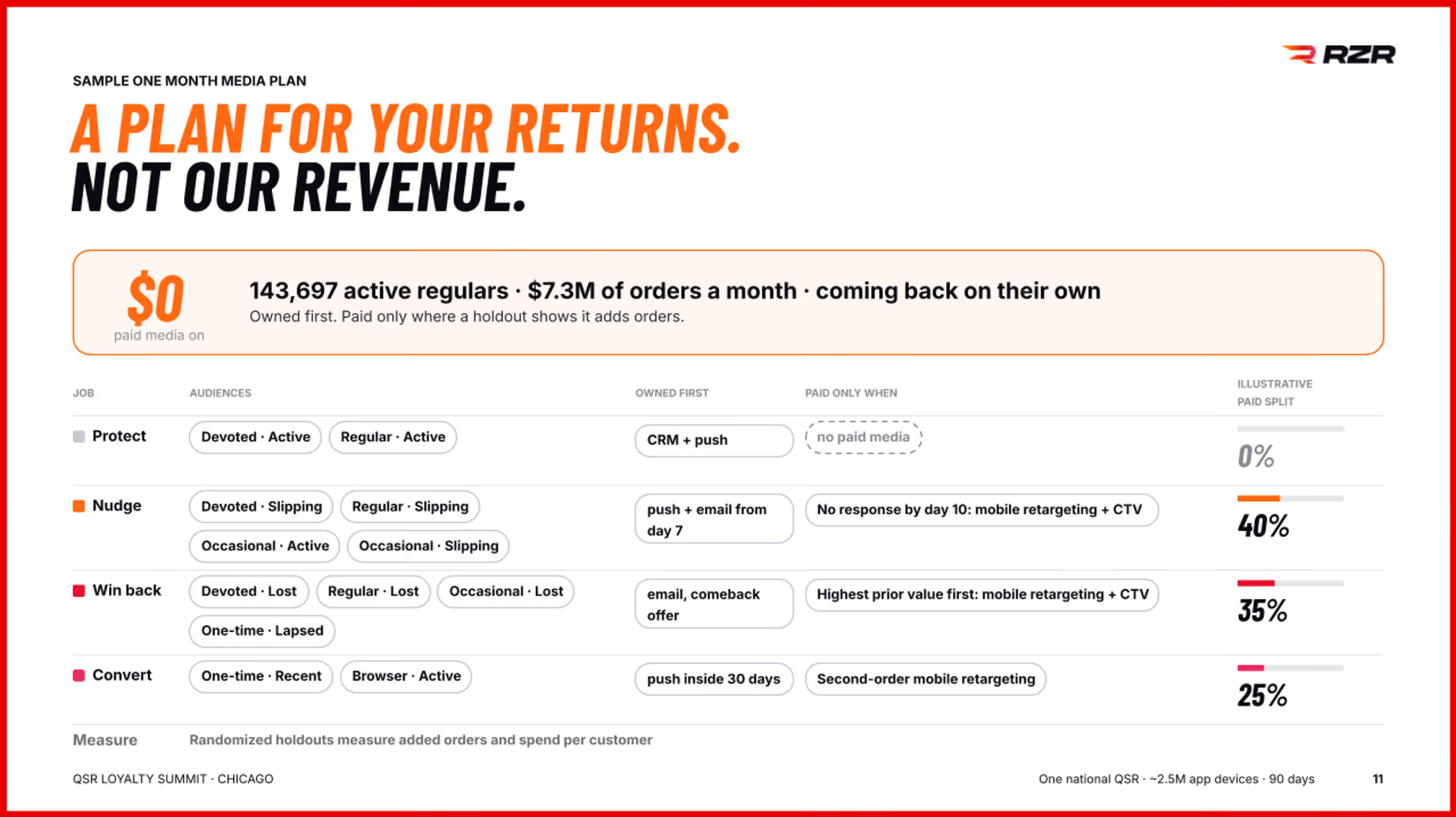
Try this: Keep active regulars on push and email, out of paid media, and use a randomized holdout to check whether paid adds orders. In RZR's sample plan, that meant $0 of paid media on about 144,000 regulars ordering $7.3 million a month.
Regulars cool off fast. The share who ordered the following week fell from 47% within three days of their last order to 35% at one to two weeks, 24% at three to four weeks and 6% after 60 days. Many lapsed-customer rules don't kick in until day 28 or 30.
"Day seven is the line where you start nudging folks," Sareen said.
Try this: Send push and email from day 7, ideally a one-tap reorder of the customer's usual (an ask from Reed Kuhn, Head of Business Strategy at Branch). Add mobile retargeting and CTV only for customers who haven't responded by day 10.
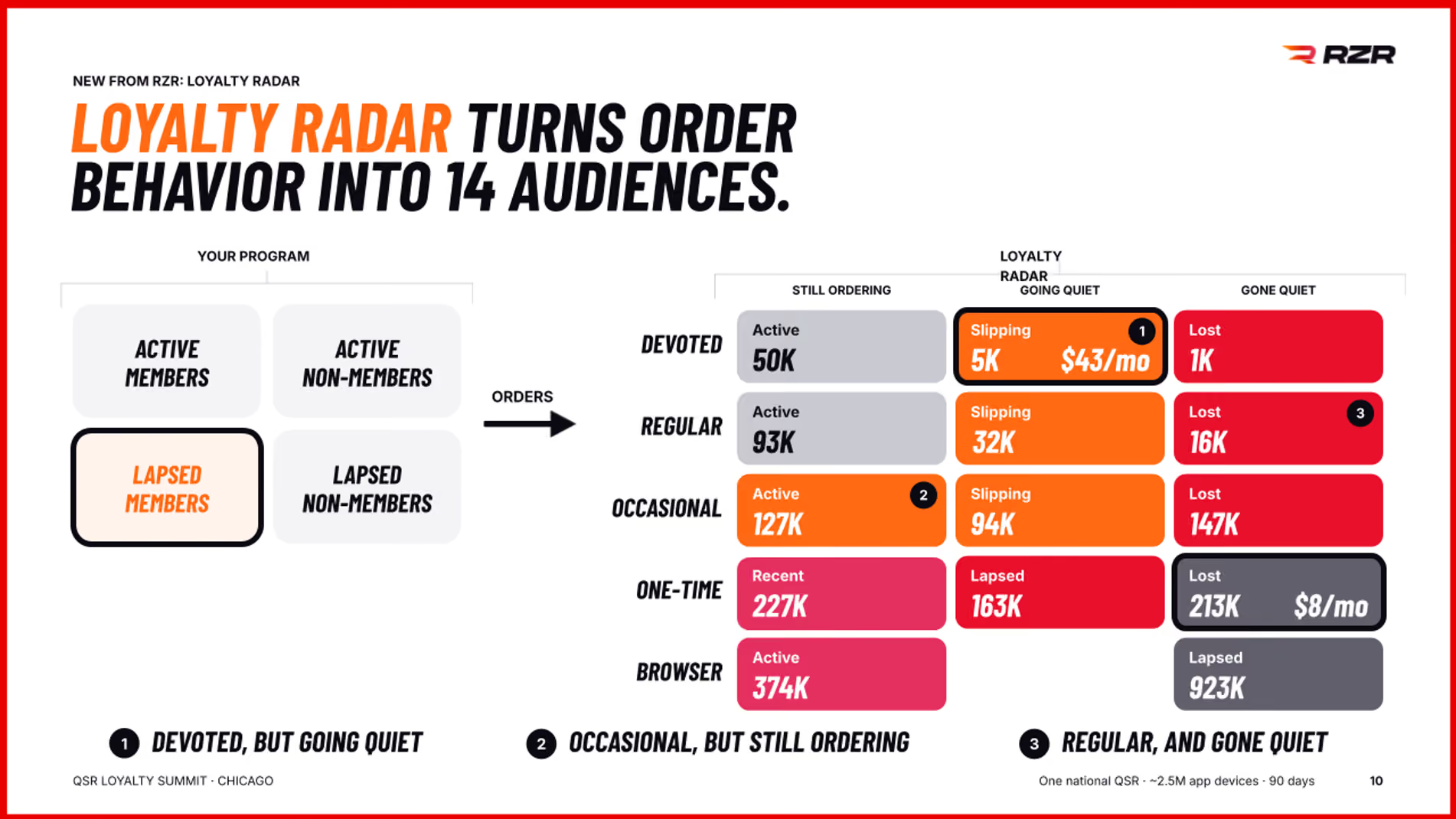
A devoted customer who's slipping spends about $43 a month; a lost one-time buyer, about $8. "You spend the same CPMs and same amount of dollars on getting both these audiences back," Sareen said.
Khaiat tiers Polymarket's win-back by value too: personal outreach for top users, email plus a promo for the middle, a push for anyone who still has the app. "You can't just do a spray and pray approach," he said.
Try this: Rank lapsed audiences by past spend and set bids and offers to match. More ideas: The Final Four of Retention Marketing.
Across QSRs, Kuhn said, Branch sees an average of more than five conversion events tracked beyond impressions, clicks, installs and opens, and one brand tracks more than 30. Tag campaigns by offer and you'll know whether the free side or the 10% off drove the purchase: "Not click, not see, but actually do." With small samples, he added, "give yourself time to reach a conclusion."
Try this: At minimum, send purchase, revenue and registration events back to every channel.
O'Connor warned against marketers who "dump leftover money into some new channel" at quarter's end. Khaiat said the big social platforms take scale at large budgets "but not efficiently." That's when a DSP earns a test, if it's transparent about where your ads run.
Try this: Set the budget and success criteria up front, and require reporting on where every ad ran.
Matt Mittal, Regional VP of Agency Development at Magnite, told performance buyers to start by "trading rigidity for flexibility": buy audiences instead of picking shows. His starting split:
Watch the fees: Mittal estimated 10% to 40% of a CTV budget goes to them. The ANA's Q3 2025 benchmark found 47.1% of all programmatic spend reached publishers.
Try this: Start broad and let performance data choose your inventory. New to CTV for performance? Read What is CTV for mobile performance?
Attribution can now match a purchase on a phone to a TV ad that played on the same home internet connection days earlier, Kuhn said. Khaiat said CTV gives his team user-level data, while linear TV measurement never gives a final answer. Massaro's caution: measure CTV on installs and you're "probably hitting people who already have the app." Measure incremental orders against a holdout instead.
Timing matters too. A coffee ad can work on the morning commute, Khaiat said, but "you're not going to get a Starbucks most likely at 6, 7 PM."
Try this: Add connected TV to retargeting for high-value households going quiet, and schedule creative by daypart and occasion.
Before you plan next quarter, pull three numbers from your order data:
If the first is large, the second isn't zero and the third is 28, you know where your next dollar should go.
Most loyalty programs sort app customers into four boxes: active or lapsed, member or nonmember. That puts a devoted customer worth $43 a month in the same lapsed box as a one-time buyer worth $8.
Loyalty Radar, RZR's new audience product, uses the order data you already send your MMP to split those four boxes into 14 audiences by order frequency and recency. Each comes with a value and a job (protect, nudge, win back or convert), so every ad dollar goes where it can add orders.
Sources: Session recording and slides, RZR QSR Loyalty Summit, Chicago, October 13, 2026; Circana, June 12, 2025; ANA Programmatic Transparency Benchmark, November 5, 2025.


Get cutting-edge insights on retention-led growth straight to your inbox.

