/* zh - CN text size */
Blogs

What is CTV for mobile performance?

The top 10 questions mobile app marketers ask us about CTV for mobile outcomes — answered

Ariel Neidermeier
May 26, 2026

Earlier this month, every major streaming and broadcast network took the stage at this year’s Upfronts and made essentially the same pitch to media buyers: performance.

As reported by AdExchanger, every publisher used the word "performance" like it was their job. Because this year, it was. A survey of 300 marketers heading into upfronts found that business outcomes topped the list of what brands consider most critical when buying and negotiating media, cited by 45.5% of respondents. This outranked tried and trusted metrics like verified ad delivery, efficiency, and program ratings. A separate survey of 120 brand and agency leaders found that 68% would increase CTV investment further if stronger proof of business outcomes were available.

So, basically, CTV is a performance channel now. What's less clear — and what no upfront presentation is going to walk you through — is what that actually means for an app. 

  • How does a living-room impression become a mobile install? 
  • How does attribution work when the ad isn't clickable? 
  • And how do you know it's actually driving results?

That's what this piece covers.

What the heck is CTV for Mobile Performance Anyways?

First, let’s cover the basics.

The core challenge with driving mobile outcomes via CTV impressions is that CTV ads aren't clickable. There's no tap, no redirect, no last-touch event. Someone sees your ad on their TV, picks up their phone an hour later, and installs your app. But, standard attribution frameworks have no idea those two actions are connected.

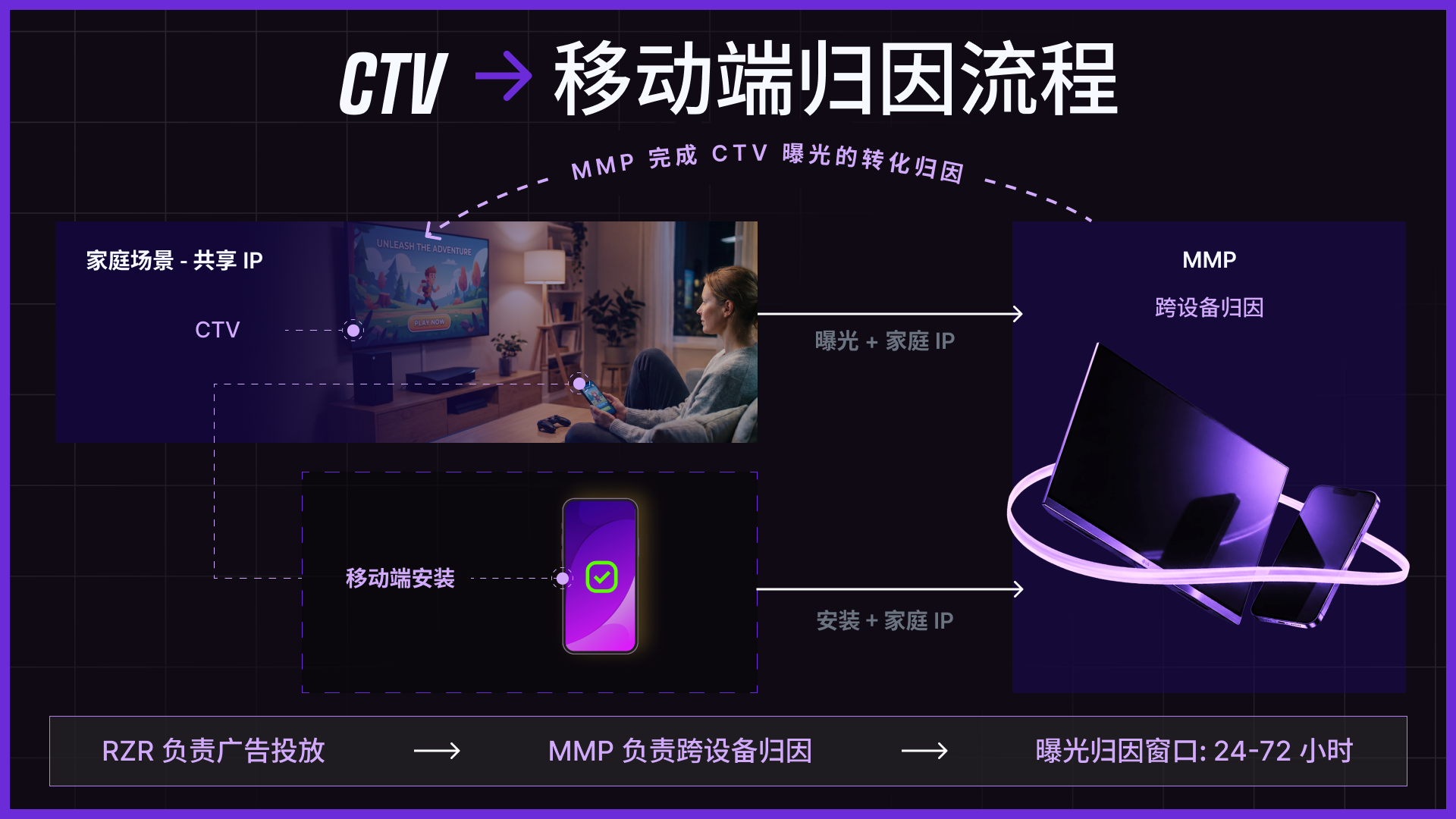
CTV for mobile performance closes that gap. Here's how it works:

  • The ad is served on a streaming device or set-top box. A DSP wins the auction and delivers the impression.
  • The impression fires to your MMP via a CTV tracking link, carrying the anonymous household IP address alongside it.
  • Your MMP records the impression in your account, with cross-platform attribution enabled.
  • A user in the same household opens or installs your mobile app on their phone or tablet.
  • The MMP performs the household IP match — same household IP means that device is a candidate for view-through credit.
  • If the install lands inside the view-through window (typically 24 to 72 hours, calibrated by vertical), the MMP attributes the CTV impression.
  • The CTV impression and mobile install land in one reporting view — blended performance, one dashboard.

The key thing to understand about this flow: the MMP is the attribution authority, not the DSP. The DSP serves the ad and fires the signal. The MMP does the cross-device matching. Most MMPS are built around this model, which means if you're already running mobile campaigns through any of those platforms, the infrastructure to measure CTV is already largely in place.

What Makes a CTV-to-Mobile Performance Partner Different

So that's the basic mechanic. 

The flow itself — impression fires, MMP matches, install attributed — is table stakes. What separates mobile performance CTV partners is what happens in the layer underneath: the signals powering the bid, the intelligence informing the targeting, and whether the system has any memory of a household before a campaign even launches.

For most CTV buys, the targeting layer is thin: Genre. Daypart. Demographics. Inventory access. For app marketers used to the performance-grade feedback loops of mobile — behavioral signals, lookalikes, LTV modeling running continuously — that gap is material.

How RZR’s Mobile Performance CTV is Different

RZR's CTV solution is built on first-party ACR (Automatic Content Recognition) data from OEM partners like LG. These are household-level viewing signals that show what a household actually watches, how deeply they engage, and when. 

While this partnership unlocks access to LG inventory, the more meaningful part is what LG’s ACR data unlocks across RZR campaigns.

First-party data that works across every screen, not just one OEM

LG's ACR data feeds RZR's bidding model across the entire CTV supply landscape — Roku, Samsung, FAST channels, set-top box inventory, and beyond. A household's content consumption patterns produce a richer, more precise bid signal on any impression, regardless of which screen it's served on, so the intelligence travels with the audience, not the device.

No cold start on new campaigns

Most CTV campaigns spend their early days learning; bidding into uncertainty until the model accumulates enough signal to optimize. Because LG's viewing graph is persistent, new RZR campaigns inherit household-level intelligence from day one. The learning period is shorter, and the path from launch to measurable performance is faster.

A feedback loop that runs in both directions

LG household IDs are matched against RZR's mobile device graph, meaning CTV viewing behavior actively sharpens how we bid on mobile inventory, and mobile behavior informs CTV targeting in return. The two channels share intelligence rather than operating in silos. That cross-channel feedback is what turns CTV from a reach buy into a channel that behaves like it has memory: one that knows what the household watched, which device they converted on, and how to bid smarter on every impression that follows.

The Questions Apps Ask Us the Most About CTV 

Since launching our CTV product earlier this year, we've fielded just about every question you can imagine about how this works. This is a reflection of where the market is. Performance CTV for mobile apps is genuinely new infrastructure, and everyone is figuring it out in real time: the advertisers, the MMPs, the DSPs, and yes, us too. 

Here are 10 questions that come up in almost every conversation.

1. The ad ran on TV. The install happened on a phone. How does my MMP actually connect them?

Through household IP matching. RZR fires the CTV impression to your MMP via a tracking link that includes the anonymous household IP. When a mobile install comes in from the same household IP within the view-through window, the MMP performs the match and credits the CTV impression. The MMP is the attribution authority — RZR supplies the signal. This is the same mechanism AppsFlyer, Adjust, and Singular all document in their CTV configuration guides.

2. Is RZR's CTV only for LG TVs?

This is the most common misunderstanding, and worth being precise about. The LG ACR data is a targeting and bidding input. It powers the intelligence layer; it doesn't restrict where campaigns deliver. Campaigns run across the full CTV supply landscape: Samsung, Vizio, Sony, Apple TV, Roku, FAST channels, gaming consoles, streaming sticks, and addressable set-top box.

3. Why use RZR versus going direct to a CTV OEM?

OEM-direct is a single-source buy. You get one supplier's inventory, one supplier's data, and metrics that lean toward viewability and household reach. RZR is multi-source and performance-optimized. Which is to say: campaigns deliver across many SSPs and many OEMs, models learn across that broader supply, and measurement closes the loop into mobile attribution that OEM-direct typically doesn't offer. 

TL;DR OEM-direct makes CTV buyable. RZR makes it measurable and optimizable for mobile outcomes.

4. How do I know CTV is driving net-new installs and not just claiming credit for users who would have installed anyway?

This is a great question, and it has a clean answer: geo-switchback incrementality testing. The framework runs in two phases with the test and control geo assignments inverted between phases, separated by a one-week cool-off. The result is two independent lift measurements from a single study, which is significantly more defensible than a single-pass geo holdout. The output is a true incremental CPI — not attributed CPI — so you know what CTV actually caused rather than what it happened to be present for. Target is 95%+ statistical confidence.

5. What signals power audience segmentation?

Several layers stacked together. 

  • Behavioral cohort segments built from purchase behavior and vertical-specific intent. 
  • First-party LG ACR viewership signals — automatic content recognition data at the content, genre, and show level — that feed the targeting models across the entire CTV supply landscape, not just LG inventory. 
  • Custom IP-based segments built from your own first-party app event data: high-value purchasers, lapsed cohorts, app-similarity audiences from adjacent verticals within defined windows.

6. Does this require a new measurement setup, or does it plug into what I already have?

It plugs into what you already have. The setup involves enabling cross-platform attribution in your MMP account, generating a CTV tracking link, and granting cost reporting permissions. If your MMP is already running mobile campaigns with RZR, the CTV addition is faster than a ground-up setup.

7. What's the typical view-through window?

24 to 72 hours for mobile install attribution, calibrated by vertical. 

  • High-urgency verticals like food delivery and ride-hail favor shorter windows because the decision happens fast. 
  • Higher-consideration verticals — RPG, fintech, subscription apps — use longer windows to capture the full decision arc. Both are configurable at setup.

8. Should my CTV creative look like my mobile creative?

No, and this is probably the most common mistake teams make when they first move budget to CTV. CTV creative is the brand-story vehicle — full screen, sound on, lean-back environment, no call to action required. Mobile retargeting creative is the conversion vehicle — direct, deep-linked, often a personalized offer tied to a specific action. They work as a sequence, not as duplicates. The CTV spot builds the household pool. The mobile retargeting creative works that pool toward the install. 

9. Is this iOS and ATT-compliant?

Yes. IDFA is not accessed for users who have opted out of tracking. No alternative identifiers — email, phone number — are used for cross-company tracking. No fingerprinting at any layer. IDFV is used solely for event attribution within your own app, which Apple explicitly permits because it is not cross-vendor tracking. The targeting is probabilistic and built on aggregated, session-based signals.

10. How fast can we launch?

Five to ten business days from kickoff to go-live, depending on MMP setup status and creative readiness. The MMP configuration is usually the longest path — enabling cross-platform attribution, generating the CTV tracking link, and setting up cost reporting permissions. If your MMP is already live with RZR for mobile, CTV goes live faster.

TL;DR

  • CTV is officially a performance channel. Every major network at upfronts this year made outcomes-based measurement the centerpiece of their pitch. 
  • The attribution mechanic works through household IP matching, and your MMP already supports it. The DSP serves the ad and fires the signal. The MMP does the cross-device matching. All MMPs are all built around this model, which means the infrastructure to measure CTV is likely already in place.
  • The view-through window is the most commonly misconfigured setting in CTV attribution. Default windows of 24 hours systematically cause CTV's contribution to disappear from the data. Extending to three to seven days, calibrated by vertical, is what lets the channel get credit for the conversions it actually drove.
  • First-party ACR data is what separates a performance CTV partner from an inventory access play. Household-level viewing signals don't just inform targeting on one OEM's screens, they travel with the audience across every impression, shortening the learning curve and producing more precise bids from day one.
  • CTV creative and mobile creative are not the same. CTV is the brand-story vehicle. Mobile retargeting is the conversion vehicle. Running them as duplicates leaves performance on the table. Running them as a sequence is where the results compound.
  • Incrementality testing is the only way to know CTV’s Impact. Geo-switchback testing — two phases, inverted assignments, one-week cool-off — produces two independent lift reads from a single study. The output is a true incremental CPI, not attributed CPI.

Ready to test CTV for your app?

Performance CTV for mobile apps is new enough that most teams are still working through the setup, the measurement configuration, and the creative strategy for the first time. We've built RZR's CTV solution specifically for apps who need the channel to be accountable to the same metrics as mobile — CPI, ROAS, incremental installs. If you want to scope a test against your own KPIs, we'll help you set the measurement layer up cleanly and run incrementality once the campaign clears its learning period.

关注我们:
智能驱动,实效不凡
© 2026 RZR GLOBAL INC
Sign up for Newsletter

Stay Sharp