What APAC’s top studios have figured out that the rest of the industry should be paying attention to
.avif)


Acquisition costs are rising, user growth is flatlining, and the market is getting more crowded. Mobile game advertisers globally reached 84,000 per month in 2025, up 21.9% year over year, with total annual advertiser volume exceeding 400,000. APAC is driving a significant share of that growth: Japan and South Korea saw active advertisers climb 56% year over year with creative output up 67%, and Southeast Asia added 26% more advertisers in the same period.
What’s more, the markets APAC studios most want to break into—North America chief among them—require a fundamentally different playbook than the one that built their initial scale.
The studios pulling ahead have figured something out: the ad is not the beginning of acquisition. It is chapter zero of the entire user relationship.
The insights in this piece draw from two webinars RZR participated in, hosted by SocialPeta and including experts from Playio, Singular, Ikanasin Production, and VX Motion Lab. What follows covers where the APAC market opportunity actually sits right now, why the standard acquisition playbook is losing its edge, and what the highest-performing studios are doing differently at the creative and retargeting layer to build growth that holds.
Southeast Asia (SEA), once a reliable blue ocean for mobile game advertisers, has flipped. Despite ranking third in global advertiser volume in 2025, SEA has become a saturated, highly competitive market. The new primary expansion target for APAC-based studios is North America, a market with different expectations, higher creative standards, and significantly more competition.
At the same time, the creative landscape is intensifying across every region.
The volume of creative output required to compete has never been higher, and the shelf life of any given creative has never been shorter.
North America posted 119 monthly creatives per advertiser in 2025, the second-highest of any global region, compared to 75 in Southeast Asia. That gap quantifies the different creative standards APAC studios face when entering the North American market.
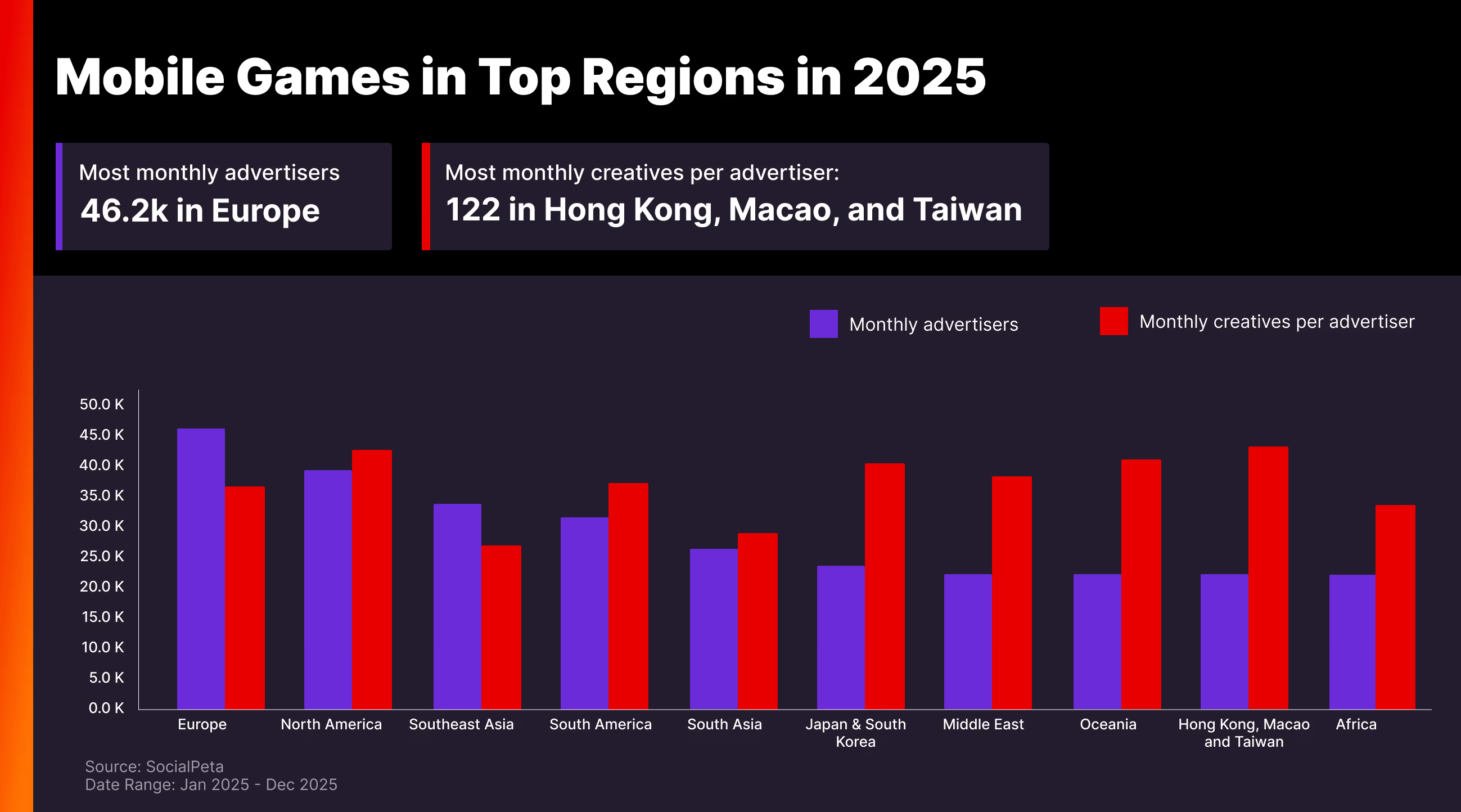
But creative volume alone doesn't explain what's driving the gap. In markets like South Korea, Japan, and Taiwan, the expectation for precision has risen alongside the expectation for volume. Studios operating there are increasingly using AI to understand what users want before they ask for it.
Jun Hao Ng, Senior Strategic Partnership Manager at Playio, described how his platform approaches this in practice: rather than targeting users based on historical spending patterns, Playo uses real-time behavioral data to identify what genre a user is likely to play next, then pushes relevant titles to match that emerging interest.
The result is acquisition built around future potential rather than past behavior. That orientation toward predictive intelligence is now a baseline competitive expectation in East Asia, and it is raising the bar for every studio targeting those markets.
The studios navigating this environment successfully share one thing in common: they’ve stopped treating the ad as a separate function from retention.
Sree Lakshmi, RZR’s GM of India, put it succinctly:
One more time for the readers in the back: 95% of users churn on day zero. This means the vast majority of players who download a game never come back after the first session. UA teams might have secured their install but something in that first experience, including possibly the creative that drove the install in the first place, failed to set the right expectation or entice them enough to open the app.
Banu Andaru Adhimuka is the CEO of Ikanasin Production, an Indonesian studio explained how this reframe happened after his studio spent years working through the challenge of scaling hybrid organic and paid acquisition. His team began building ads that functioned as narrative prologues, drawing users into the story of the game before they ever reached the install screen. When users arrived at the game, they were already invested. This smoothed the transition from ad to onboarding, and enhanced retention in the process.
This tracks with why long-form creative is rising. A 15-second ad does not have room to tell a story. A 45-second ad does. The format shift toward longer video reflects a growing understanding that the ad needs to carry emotional weight before the game can carry it forward.
What chapter zero thinking looks like in practice:
Letty Wang, RZR's Head of Sales in China, made the point directly:
"Retention doesn't just start on Day 7 or Day 30. It begins from Day 0. You need to focus on the new users you've just acquired from the moment they enter."
The numbers back it up:
The takeaway: there is a structural advantage for studios that architect their growth around the full arc, from creative to conversion, rather than treating each stage as a baton handoff between sprints.
Many studios still think of retargeting as a recovery tool. Something you deploy when a user lapses. Letty reframed it as an accelerator.
"There is no fixed stage for retargeting. We recommend early intervention — addressing Day 7 retention drop-offs — to improve retention and product performance."
She gave two actionable guidelines:
These thresholds give growth teams a concrete framework for pacing spend rather than scaling indiscriminately. The insight behind them is that UA and retargeting are most effective when they operate as one continuous system informed by the same creative learnings and behavioral data.
Sree drove the point home with data:
The Cross-Screen Dimension: Taking Chapter Zero to New Screens
For APAC studios entering North America, mobile is one piece of a larger picture.
In fact, CTV ad spending in the US increased fivefold in 2025. Users who see a CTV ad and then receive a mobile follow-up convert at meaningfully higher rates than users reached through mobile alone.
With that said, the chapter zero concept should extend across screens. A user might encounter the story on CTV and complete the loop on mobile. For studios targeting the North America geo from APAC, this cross-screen arc is increasingly the competitive baseline (not a premium strategy).
The growing and lucrative creator economy is a third channel layer: projected to surpass $300 billion by 2026, influencer-led content gives studios a way to reach established communities with native, high-trust creative formats, carrying the narrative even further upstream from the install.
None of this compounds if the creative burns out. The data from both sessions is consistent: CTR drops 45% after four exposures to the same ad. Which means in many cases, the story stops working before retention has a chance to take hold.
Teams that treat creative as a one-time output and optimize reactively, refreshing only after performance degrades, see significantly lower stability than teams with structured production cycles. In the webinar, Sree noted 30% more performance stability for proactive teams.
What a system-level creative approach requires:
The above question, applied to creative, to retargeting timing, to cross-screen sequencing, and to community and UGC strategy, is what separates studios building compounding growth from studios chasing diminishing returns on install volume.
The APAC mobile market in 2026 is harder, more expensive, and more regionally specific than it has ever been. The studios making the jump from regional to global are not doing it by spending more in a saturated channel. They are rethinking what the ad is supposed to do, and building their entire growth architecture around the answer.
The ad is chapter zero. Everything after it is the game you already started.
Watch the Webinars and Download the Whitepaper
These insights came from two live sessions hosted by SocialPeta, RZR, and Singular alongside partners from across the APAC mobile gaming ecosystem.
→ Watch the English-language session
→ Watch the Mandarin-language session
→ Download the full whitepaper



Get cutting-edge insights on retention-led growth straight to your inbox.

