March Madness drives a 130% install spike for sports betting apps — and lifts food, finance, and streaming apps with it. Here is what predictions and betting apps have figured out about turning a three-week spike into year-round retention, and what every growth team can take from it.
.JPG)

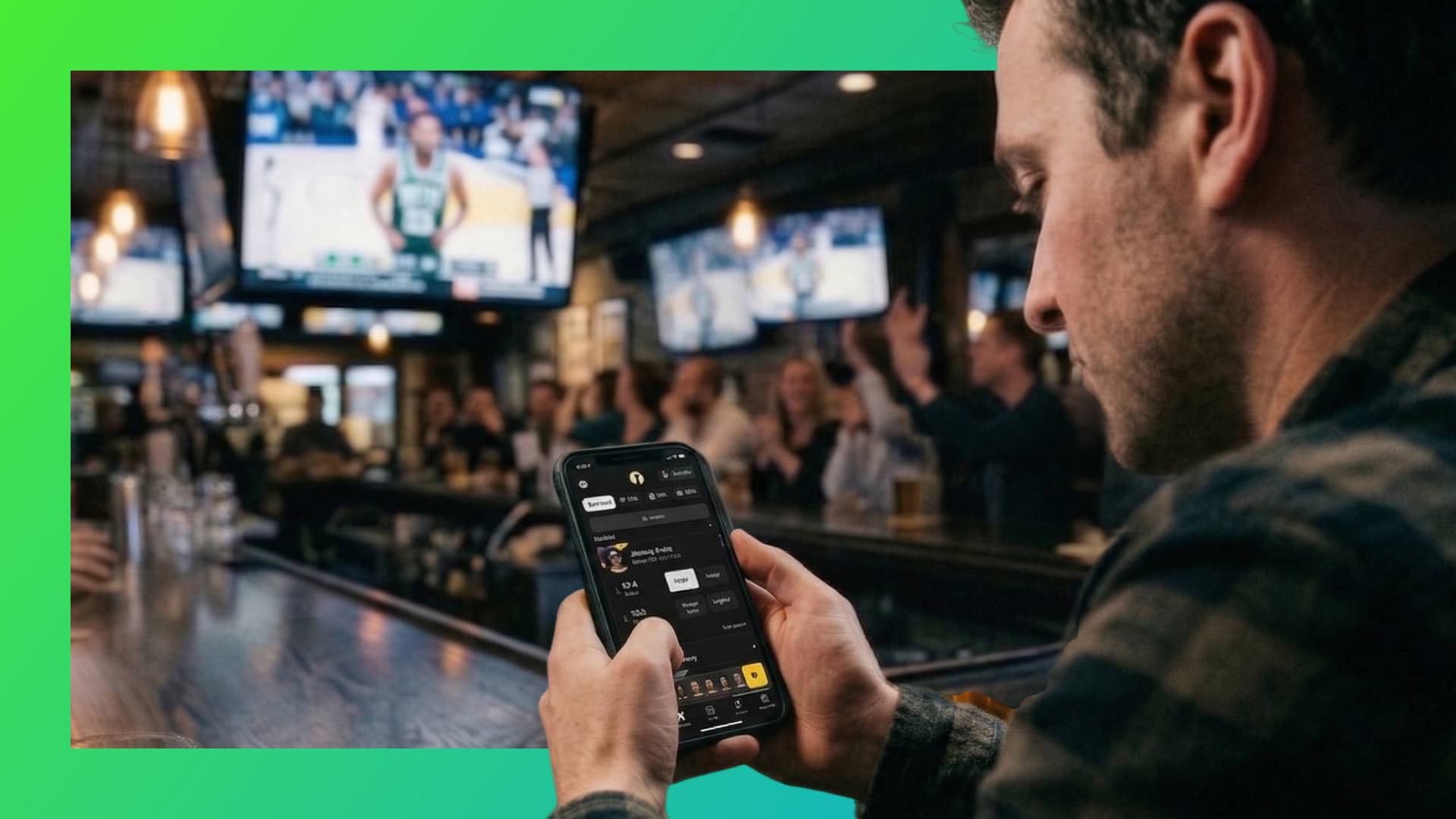
March Madness is one of the most concentrated mobile acquisition moments of the year. For three weeks, tens of millions of users download apps, deposit money, fill brackets, and place bets at a pace that most verticals never see outside of a product launch or a viral moment.
According to a joint report from AppsFlyer and Sensor Tower on the 2025 NCAA Tournament, the lift raises the entire app economy:
What the data makes clear: March Madness does not just belong to sports apps.
The question is what to do after March Madness engagement peaks — because it does peak. By the National Championship game, sports betting app opens dropped 39% compared to the Final Four and 37% versus opening weekend.
In other words, the spike is real. So is the drop-off. And the gap between the two is where most growth teams leave their biggest returns on the table. The apps that have built systems to capitalize on that window — before, during, and after the bracket — are betting and predictions apps. Here is what they've figured out about retention, and what every other app can take from it.
The 2018 Supreme Court decision in Murphy v. NCAA ended the federal prohibition on sports betting and effectively launched one of the fastest-growing app categories in US history. Within months, DraftKings, FanDuel, and BetMGM were competing for users in newly legalized states with aggressive acquisition spend, sign-up bonuses, and a product experience purpose-built for mobile.
The growth trajectory was steep:
These numbers tell the category challenge plainly: massive volume, low loyalty, and a user base conditioned to chase the best offer. What does this necessitate?
→ Re-engagement infrastructure, behavioral segmentation, and event-driven marketing systems that keep bettors coming back.
Where sports betting apps built the playbook, predictions apps rewrote it entirely. Platforms like Kalshi and Polymarket operate as federally regulated financial instruments — event contracts overseen by the Commodity Futures Trading Commission (CFTC) — that allow users to trade on the outcome of real-world events across sports, politics, economics, and pop culture.
The scale of growth in this category is near impossible to overstate. According to Gaming Insider, in early 2024, monthly notional trading volume across all major prediction market platforms combined sat below $100 million. By November 2025, that figure had crossed $13 billion in a single month.
The full-year numbers tell the same story:
Sports contracts have driven the majority of this volume but the category's mainstream cultural expansion is also impossible to ignore. At the 98th Academy Awards, traders poured more than $120 million into Oscars event contracts on Kalshi and Polymarket combined, the largest awards-season volume ever recorded on regulated prediction markets. Kalshi alone processed $58 million in a single evening (Forbes).
Together, these two categories have built the sharpest performance marketing playbook for capitalizing on high-intent moments that every growth team can learn from.
The lesson is precise audience segmentation. To win big during high-intent moments, growth teams should arrive with their audience already defined. For example, sports betting apps segment by bettor type, deposit behavior, and sport affinity before a single game tips off. Here is what that looks like in practice:
Mitch Solomon, VP of Growth at Underdog, puts it plainly: "Going into a major event like March Madness, we lean on prior play data and known regional trends tied to local team success. But bridging the gap between a tentpole moment and more evergreen behavior is almost as important as capturing that first-time deposit. And throughout all of it, we stay tightly aligned across our marketing orgs to make sure our execution feels cohesive and distinctly Underdog."
The drop-off post-March Madness is real, but it is not uniform, and that distinction matters for every app. After the 2025 NCAA championship game, sports betting app opens dropped 39% but food and drink apps saw a 13% increase in opens and finance apps rose 10% (AppsFlyer/Sensor Tower). For these latter categories, the tournament did not end user intent, it redirected it.
The takeaway for growth teams?
Instead of fighting the drop-off, plan for it. Know which moment in the event arc belongs to your app, build distinct creative for each stage, and have your re-engagement campaign ready before the bracket is filled out.
A persistent false choice in growth marketing is the one between brand spend and performance spend. Brand builds awareness and trust. Performance converts that trust into measurable action. Run them together and make your ad spend work harder.
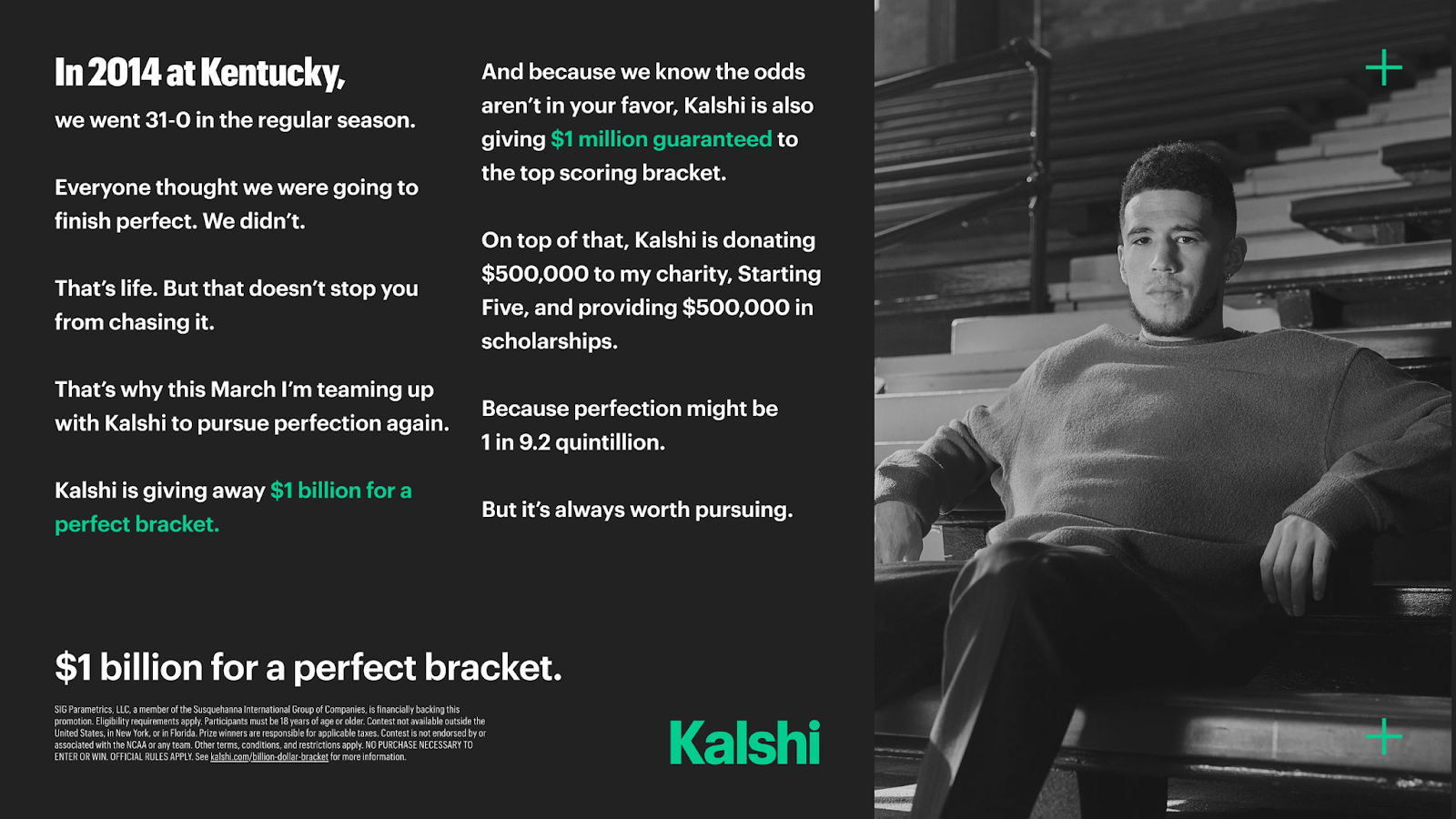
Kalshi's $1 Billion Perfect Bracket Challenge with Devin Booker is a great example of what this looks like in practice. The celebrity partnership builds cultural credibility and earns organic media. The $1 billion prize generates the kind of reach no paid campaign budget can replicate. And the bracket mechanic drives measurable daily actions — sign-ups, deposits, re-engagement check-ins — across three consecutive weeks of tournament play.
The highest-LTV users in sports betting and predictions apps are not the ones who showed up for March Madness. They are the ones who stayed for the NBA playoffs, re-engaged during the NFL draft, and came back in September when the season kicked off.
Sensor Tower data from 2023 to 2025 shows that across sports betting and predictions apps, fans stay engaged year-round — with off-season events like drafts, player trades, and major sporting news continuously reinforcing in-app behavior. The tournament is the entry point. The calendar is the retention strategy.
.png)
Every app has a version of this. A product launch cycle, a seasonal moment, a recurring cultural event that drives acquisition. To compound LTV, growth teams must build engagement surfaces for the gaps between tentpole moments, so users have a reason to stay active when the spike is over. March Madness ends April 7th. The sharpest teams already know what they are running on April 8th.
March Madness is a masterclass in high-intent mobile behavior. The apps that win through it — and after it — share four traits: they arrive with their audience already segmented, they treat the drop-off as a re-engagement opportunity, they run brand and performance as connected levers, and they build for the full calendar rather than the spike.
March Madness ends April 7th. The retention work starts April 8th. If you want a growth partner who knows how to capitalize on every round — not just the spike — let's talk.
Get cutting-edge insights on retention-led growth straight to your inbox.

