How to acquire and re-engage players across every screen
.avif)


Mobile gaming accounts for 55% of global game revenue and serves nearly 3 billion players worldwide. But that scale is getting harder to sustain.
Global mobile game downloads fell 7.2% in 2025. In-app purchase revenue grew just 1.3% over the same period. Players are concentrating on fewer titles and the cost of reaching new ones keeps climbing. The ones who do install are churning before they generate meaningful return.
This is not a problem isolated to casual or hypercasual gaming. The retention and acquisition pressure runs across every genre — puzzle, strategy, RPG, midcore, and beyond.. The studios closing that gap are finding their players on a different screen. Here's how.
Retention data makes the structural challenge plain.
According to GameAnalytics’ 2026 Mobile and PC Gaming Benchmarks Report, across more than 16,000 live mobile games on iOS and Android in all genres in 2025:
At the same time, the gap between top performers and everyone else is widening. In 2025, top 1% titles retain 64-68% of players at Day 1 and hold over 25% through Day 7. That means the median game retains fewer than four players out of 100 by the end of its first week.
By Day 30, over 95% of mobile game installers churn across both iOS and Google Play.
The cost side of the equation compounds the problem.
According to RZR data, UA costs rose 12% year-over-year while gaming marketing budgets increased 26%, yet user growth remained nearly flat at 2%. The gaming industry spent $25 billion on user acquisition in 2025. Average CPM across all mobile game genres grew 20% year-over-year in 2025, rising from $3.63 to $4.34.
The paid-to-organic install ratio grew 61% in 2025, moving from 2.07 to 3.33 — meaning studios are relying more heavily on paid acquisition at precisely the moment it costs more.
Fewer than 5% of mobile game users monetize. In casual genres, that figure drops below 2%. Break-even now stretches beyond 90 days for most titles (Aarki internal data, 2025). The takeaway? Publishers are spending more to acquire players who generate less and stay for shorter periods.
Before addressing how CTV changes the equation, it helps to ground the conversation in what performance benchmarks look like across the industry today.
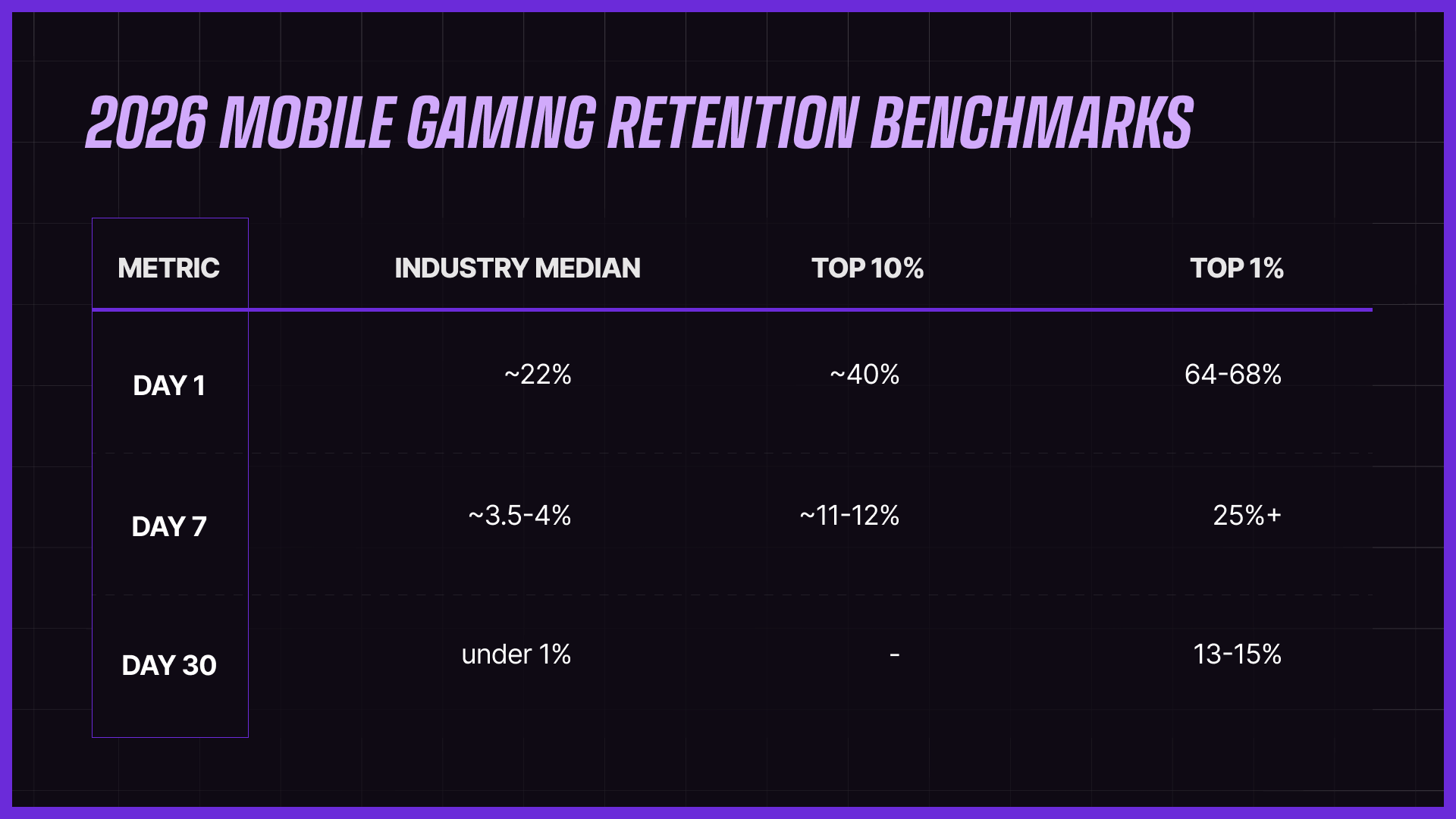
What these benchmarks reveal: the distance between median performance and top-tier performance is growing. Top 1% retention is roughly 3x what top 10% titles hold, and more than 30x the industry median at Day 30. The studios closing that gap fastest are the ones adding channels that reach players with precision across more than one screen.
CTV campaigns unlock a significant opportunity for mobile games looking to reach players where they're already spending their time.
According to LG Ad Solutions' research on US gamers, half of all gamers play two or more times per week, and 8 in 10 are watching TV primarily through streaming services rather than traditional cable. Rather than passive viewers, these are active participants in a dual-screen experience where mobile and TV viewing happen simultaneously.
The data shows that there is an opportunity to reach your existing players where their attention is most focused and where they're most receptive to ads: CTV.
In fact, around 77% of people use their phones while watching TV, creating a natural bridge between awareness on the big screen and action on mobile devices. When a player sees your game promoted during their evening streaming session, their phone is already in their hand.
CTV earns a role in a mobile gaming growth strategy through two functions that compound each other.
CTV campaigns built on deterministic household-level data reach audiences based on actual viewing behavior. TV manufacturer partnerships enable targeting through Automatic Content Recognition (ACR) technology — meaning audience segments are built on what people demonstrably watch. A strategy game can target households with verified engagement with competitive content. A casual puzzle title can reach viewers with documented lifestyle programming consumption. Suppression of already-exposed households keeps budget concentrated on incremental reach.
Players who see a CTV ad but don't convert within the attribution window remain addressable. Their household data creates a re-engagement pool. Programmatic mobile campaigns follow those users on the device in their hand, reinforcing the message across screens. The player who saw the creative during an evening streaming session encounters it again in the context where converting is frictionless.
The loop extends beyond initial installs. Players who downloaded but went dormant can be re-exposed on CTV with content tied to new game features, seasonal events, or limited-time offers, then reached through mobile retargeting to drive return sessions.
When run on a unified platform, both phases of that loop share audience data, creative intelligence, and attribution infrastructure. Each acquisition cycle makes the retargeting pool sharper. Each re-engagement campaign informs the next round of prospecting. The system compounds.
The approach matters as much as the channel. The studios extracting the most from CTV treat it the way they treat any mobile performance channel: defined KPIs, iterative optimization, and attribution infrastructure built before spend scales.
Set specific targets around cost per install, Day 7 retention, and return on ad spend from CTV exposure. Build reporting that connects TV impressions to mobile outcomes through your MMP. Apply frequency caps at the household level. Define holdout groups for incrementality testing so CTV's contribution is measured independently of other channels in your mix.
Mobile gaming's retention benchmarks are declining across genres. UA costs are outpacing player growth. Publishers who rely on a single screen and a single-phase acquisition strategy are absorbing those costs without the offset that a coordinated cross-screen approach provides.
CTV adds a high-attention, performance-optimized channel to a growth strategy that most studios are running entirely on mobile. It reaches the players you are already targeting in an environment where they are more receptive, with a phone in their hand to act on what they see.
RZR builds CTV campaigns like mobile campaigns: with ROAS targets, MMP integration, and audience suppression that keeps every dollar working on incremental reach. For gaming publishers ready to close the gap between acquisition spend and player value, the opportunity is on the screen in the living room.
If your growth strategy lives on one screen, it's time to add another. See how RZR runs performance CTV for mobile game publishers.



Get cutting-edge insights on retention-led growth straight to your inbox.

