Here's how mobile retailers can capture it
.avif)

.avif)
For the first time in mobile history, consumers spent more money in non-gaming apps than in games during 2025. Non-gaming in-app purchases reached $85.6 billion, representing a 21% year-over-year increase and 2.8 times the amount spent just five years earlier. Gaming apps generated $81.8 billion with only 1% growth, signaling a fundamental shift in how consumers shop on mobile devices (Sensor Tower).
.avif)
Mobile commerce now represents 59% of global retail e-commerce sales, totaling approximately $4.01 trillion in 2025 (SQ Magazine). This figure has already surpassed earlier projections that estimated mobile commerce would reach $3.35 trillion by 2028 (Capital One Shopping). In the United States specifically, mobile retail e-commerce sales hit $710 billion in 2025 (SQ Magazine).
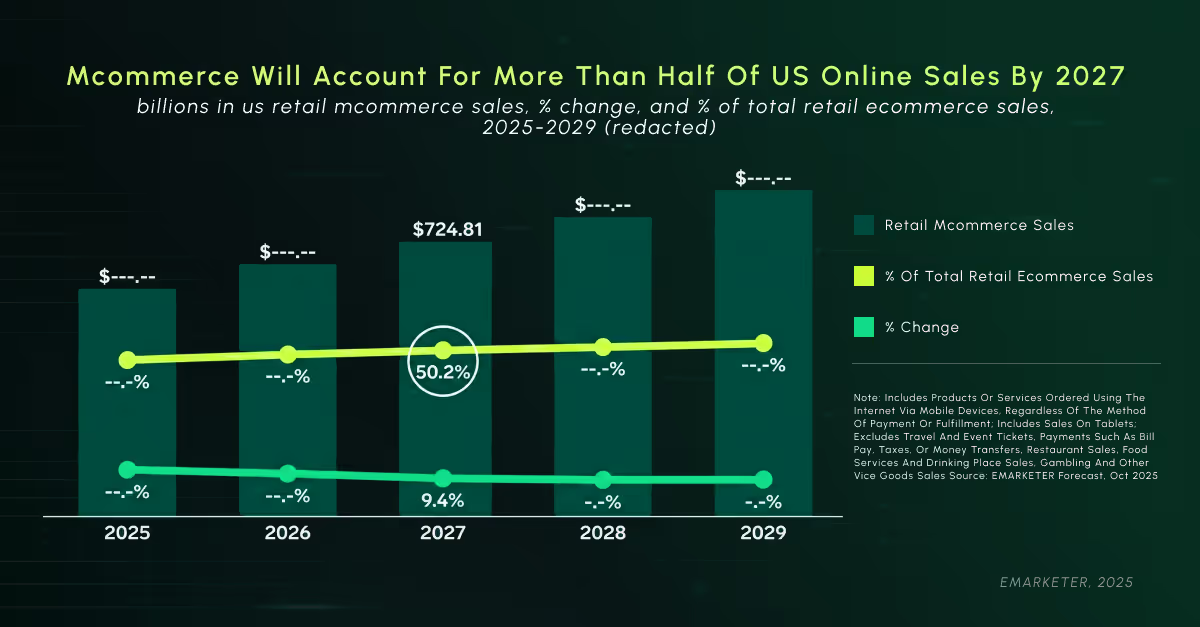
Put simply: if you're a retail brand, the majority of your customer interactions are happening on mobile devices right now. The question isn't whether to invest in mobile. The question is whether you're investing in the right mobile strategies to actually convert that engagement into revenue.
Your customers are on their mobile devices. A lot. Here's exactly how much:
The data gets even more interesting when you compare mobile app engagement to mobile web:
What we’ve learned so far: mobile commerce owns 59% of global retail sales. So why are most retailers still underperforming?
Here are three fixable mobile performance gaps that are costing retailers billions in lost conversions.
Right now, 85.65% of shoppers who add items to their mobile cart leave without buying (SQ Magazine). That means you're losing 85 out of every 100 potential customers at the finish line. Even just closing the gap between desktop (69.32%) and mobile (85.65%) cart abandonment could mean the difference of billions of recoverable revenue.
What the data shows:
How to fix it:
Mobile generates the majority of traffic yet converts at 2.85%, while desktop converts at 3.9% (SQ Magazine). This gap means you're paying to acquire mobile traffic that underperforms compared to desktop visitors. The good news? Mobile apps convert at twice the rate of mobile web, proving the conversion gap is fixable with the right approach.
What the data shows:
How to fix it:
Your mobile app might be losing a third of your revenue before customers even reach checkout. The culprit? User experience design that creates friction like slow load times, clunky navigation, and complicated checkout flows. Fixing your UX can deliver measurable results: retailers who invest in mobile UX see conversion rates jump as much as 400% (SQ Magazine).
What the data shows:
How to fix it:
Mobile commerce represents 59% of global retail sales and $4.01 trillion in annual revenue. The infrastructure is built and the customers are engaged. What separates winning brands from the rest is execution: recovering abandoned carts faster, converting mobile traffic at app-level rates, and delivering experiences that keep customers coming back.
Mobile commerce has fundamentally shifted: Non-gaming app revenue ($85.6B) surpassed gaming revenue ($81.8B) for the first time in 2025, proving mobile is now the primary channel for consumer transactions across all categories.
The engagement advantage is undeniable: With consumers spending 3.6 hours per day in apps and mobile apps converting at 2x the rate of mobile web, app-based strategies deliver measurably superior performance.
Three fixable gaps are costing billions: Cart abandonment (85.65% on mobile vs 69.32% on desktop), conversion rate gaps (2.85% mobile vs 3.9% desktop), and poor mobile UX (88% of apps score "mediocre" or worse) represent the largest opportunities for improvement.
Apps outperform mobile web by every metric: 85% of U.S. shoppers prefer apps, apps deliver 2x conversion rates, and average order values run higher in app environments thanks to personalization and seamless checkout.
The winners will be mobile-first by design: Retailers that prioritize app experiences, implement real-time cart recovery, optimize for mobile wallets, and invest in world-class mobile UX will capture disproportionate market share as mobile commerce continues its accelerated growth trajectory.
RZR powers performance for e-commerce and gaming brands through proprietary neural architecture that optimizes across user acquisition, retargeting, CTV, and influencer campaigns as one connected growth engine. Our machine learning platform identifies high-value users, predicts conversion probability and lifetime value at impression, and delivers the real-time optimization that turns mobile traffic into measurable revenue.
Ready to close the mobile performance gap? Contact RZR to learn how our platform can help you recover abandoned carts, boost mobile conversion rates, and scale profitable customer acquisition across channels.



Get cutting-edge insights on retention-led growth straight to your inbox.

